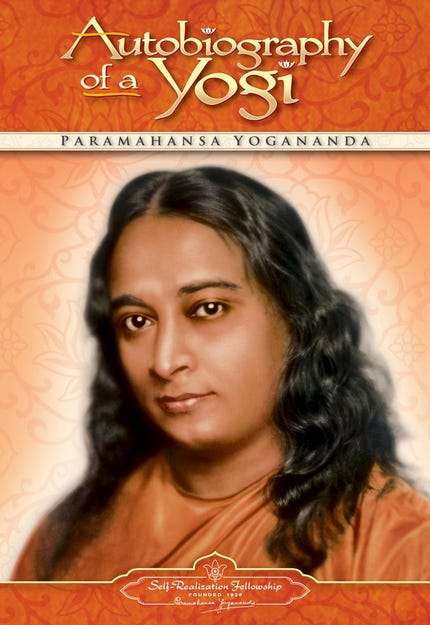

Despite my study of religion and the fact of my being a yogi, both hatha-based and kundalini, for the duration of my entire adult life, and despite its prominent display in many of the bookstores I frequented, I never felt drawn to Paramahansa Yogananda’s Autobiography of a Yogi. It reminded me of the type of westerner who travels east to find god, (god is here and now,) only to find a lot of humans (god is in everyone). I had known a number of such young men. One had pursued graduate studies in religion and really ought to have known better, yet he returned from his lengthy stay in India reporting disappointment at not having made any progress at all toward enlightenment or having encountered transcendence of any kind.
Steve Jobs, founder of Apple, famously arranged for attendees of his memorial service to be given a copy of Autobiography of a Yogi. As the story goes, he first read the book when he was in his teens. At the age of nineteen, in 1974, he took Autobiography along with him as he embarked on a seven month spiritual retreat in India. While the short-term expectations of the trip - meeting a guru, quick enlightenment - did not come to bear, the long-term personal and creative growth made it one of the most important periods in his life. Many biographers and Jobs himself framed it as essential to who he became. The appreciation he developed there for the intuitive faculty, as well as a boundless possibility mindset, would later become foundational to Apple’s philosophy.
I did eventually read Autobiography, perhaps in the last two or three years. The back cover blurb of my copy reads: “Named one of the 100 best spiritual books of the 20th century, Paramahansa Yogananda’s remarkable life story takes you on an unforgettable exploration of the world of saints and yogis, science and miracles, death and resurrection.” Let’s briefly put the work in its religious and cultural context. Autobiography of a Yogi sits within the Hindu religious framework, more specifically within a modern yogic devotional tradition that draws on core philosophical teachings of ancient Hindu scriptures (the Vedas and Upanishads) which explore the nature of reality, the self, and the divine, especially the insight that our deepest self is not separate from the ultimate reality or God (Advaita Vedanta, non-dualism.) In terms of practice, it belongs to the Kriya Yoga lineage of Mahavatar Babaji, Lahiri Mahasaya, and Swami Sri Yukteswar. At the same time, it weaves in strong bhakti (devotional) elements and simplified Tantric subtle-body practices focused on energy and inner awareness. The book also reflects a distinctly 20th-century cultural synthesis: a globalized reinterpretation of Hindu spirituality that harmonizes Indian traditions with Western (including Christian mystical) sensibilities, emphasizes direct experience over doctrine, and presents yoga as a scientific method of God-realization. Paramahansa Yogananda founded the Self-Realization Fellowship, best described as a modern universalist devotional yoga movement, in Los Angeles in 1920. He published his autobiography in 1946 under its auspices.
What I found most striking about Autobiography of a Yogi was its genius as a tool of persuasion crafted for the western mind. In Hinduism and Buddhism exists the concept of siddhis, supernatural abilities said to develop as a byproduct of disciplined spiritual practice. These include levitation, bilocation, materialization of objects, clairvoyance, telepathy, and the like. Hinduism generally considers siddhis incidental byproducts of spiritual practice, possible but not the goal, while Buddhism views them as phenomena that may arise within awareness but are ultimately irrelevant to true awakening. Each tradition strongly warns against seeking siddhis or becoming attached to them, viewing them as potential obstacles to enlightenment and even sources of spiritual downfall if misused. While Yogananda consistently emphasizes that such powers are secondary to god-realization, his book is filled with them. Indeed, despite repeated warnings against fascination with the supernatural, the “remarkable life story” promised on the back cover delivers exactly that: an unforgettable exploration of saints, yogis, science, and miracles. Chapter 30, “The Law of Miracles,” offers a philosophical and quasi-scientific explanation for how such powers operate. Drawing on Vedanta, yoga, and even Einstein’s relativity, Yogananda frames miracles as the result of mastering higher laws of consciousness and the subtle “light of creation.” He explains them as natural side effects of divine realization, always subordinate to the true goal of god-union. Enchanting and much more appealing to a novice than a dense philosophical treatise, tales of the extraordinary sit at the heart of the book’s appeal. It is easy to see how a starry-eyed young man hungry “for something more” might be inclined to go searching for its evidence in supernatural phenomena, especially if those are presented not merely as religious belief but practical science. All the more so if he wishes to be “something more” himself.
The common consensus among scholars is that Autobiography of a Yogi is best understood as a gateway text rather than a rigorous philosophical or scholarly one, functioning primarily as an initiatory work that sparks curiosity and reorients the reader toward direct spiritual experience. I would call it masterful marketing for the Self-Realization Fellowship, and Kriya Yoga: come for the wonders, stay for the inner reckoning. The book’s publication in 1946 dramatically expanded the organization’s reach, drawing in a wide audience that might never have encountered Yogananda’s yogic teachings otherwise. The 26 years between the organization’s founding in America and the release of Autobiography presented ample opportunity for Yogananda to grasp the western culture and mentality. The book’s vivid miracles read like scenes from a Hollywood film, its reverent treatment of Christ alongside Indian masters bridges the familiar with the foreign, and even its recurring motif of the automobile as a symbol of freedom and journey all combine to make ancient yogic wisdom feel exciting, approachable, and spiritually compatible with a Western, often Christian-raised sensibility.
It is said that Steve Jobs read Autobiography of a Yogi every year. Still, after returning from India, he went on to become a dedicated practitioner of Zen meditation. A decades-long Zen study and meditation practice like his suggest the sincerity of someone who was ultimately more interested in the moon than in the finger pointing at it. Though one might argue that all roads lead to Rome, Zen’s minimalist, austere, non-theistic nature stands in clear contrast to the highly structured, energetic, devotional approach of Yogananda’s Kriya Yoga. Its influence is evident in Apple’s signature simplicity and elegant design. But what, I wonder, compelled Jobs to reread Yogananda year after year? As a memorial gift, the book makes sense in terms of the weight of its influence on the young Jobs as well as its accessibility even to those who are not spiritually or philosophically inclined. Perhaps in his annual rereading of the text, Jobs sought to stay in touch with the young version of himself, to always remember those early transformative years? I have mentioned already that India and Yogananda inspired Jobs to adopt what would become his famous emphasis on intuition and trusting one’s own perception as well as a mindset of “staying hungry, staying foolish,” open to possibility. But there is also this: an iPhone is full of siddhis. The bilocation of the video call. All the world’s knowledge. Global navigation. Photographic memory. The ability to map constellations with the bare eye. The clairvoyance of seeing what someone halfway around the world ate for lunch that day. Musical ability to play any song. And so on. It is possible to purchase these without training the mind for the skillful means to negotiate any of them. We have dopamine addiction, thought outsourcing, and outright vices like online betting and worse. I suppose what I’m getting at is the commonly held view that this type of technology came at humanity much faster than our ability to integrate it psychologically, socially, spiritually in a healthy manner.
The Yogananda/Jobs/product design connection points to a broader defining dynamic wherein spiritual concepts, like the non-dualism Jobs found in Autobiography, or the Zen emphasis on no-mind (mushin), direct non-dual awareness, are being externalized into products and platforms, yet frequently detached from the rigorous ethical and inner development that once accompanied them. There are echoes in product metaphors: “frictionless” experiences, “seamless” interfaces, “flow states,” AI as extended mind, VR/AR dissolving physical boundaries, and rhetoric around “expanding consciousness” or “connecting everything.” Much of tech culture adopts the language and/or attempts experiential simulation of spiritual development while prioritizing growth, engagement, speed, and profit, and often comes with well-documented ethical shortfalls (addiction-by-design, surveillance, polarization, mental health impacts, etc.). This move toward an artificial simulation of the spiritual seems to me at once a reflection of a collective spiritual hunger and the product of a mindset more interested in becoming god-like than having a genuine orientation toward god-realization. In the face of this hunger and hubris, the counterweight remains what it has always been: sincere, embodied practice.
Let us, then, cultivate humility and finish today with a quote from Yogananda, as well as the opening passage of the Metta Sutta, often used in traditional Zen practice.
Yogananda said: “I gave the powers back to God, and I never use them unless He tells me to. My mission is to awaken love for God in the soul of man. I prefer a soul to a crowd, and I love crowds of souls.”
The Metta Sutta says:
This is what should be done
By one who is skilled in goodness,
And who knows the path of peace:
Let them be able and upright,
Straightforward and gentle in speech,
Humble and not conceited,
Contented and easily satisfied,
Unburdened with duties and frugal in their ways.
Peaceful and calm and wise and skillful,
Not proud or demanding in nature.
Let them not do the slightest thing
That the wise would later reprove.
Suggested reading:
Autobiography of a Yogi by Paramahansa Yogananda
Metta Sutta: Loving-Kindness in Plain English - Bhante Henepola Gunaratana